Hello Dynamo people!
Today we take a slightly different tack in our blogversation (Oof, what a mouthful), diving a bit into how we cultivate and curate ideas and who ultimately drives the decisions behind what we do (Hint: It’s you!). Looking back over the past couple of years, we will explore a mountain of requests from the Dynamo user base, which we collected through a “Dynamo World Tour”. In this world tour we sought to understand the pain points and passion of Dynamo users, spanning many geographies, nationalities and experience levels.
The development of Dynamo is based on numerous factors that intersect technology, design, and business. All of these factors are bound incredibly powerfully by a desire to defend the customer: to defend you, your ideas, your desires, and your wants. It is the intersection of all of these things, the intersection of the quantitative and qualitative realms, of small and large scales, of immediate and future needs that gets us out of bed in the morning excited to tackle a new day of building the very best possible Dynamo that we can. It’s an honour for us, and the team takes great delight in seeing the passion and growth of the Dynamo community.
TL:DR
We spent time with 130+ users, coming from 44+ firms in North America, Europe, Asia and Oceania, where we gathered feedback on where Dynamo should go across the following 3 years. From the 265+ requests, we have positively honoured 60% in some way. We are mindful that this is a snapshot in time, and want to run this exercise again, so are putting out a Call to Action: Do you want to participate in the next round? If so, please register your interest here.
So what was this “World Tour”?
During the early half of 2019, a series of professional and personal travel opportunities (Oh for the world pre-Covid) meant we were present in North America, Europe, Asia and Oceania all in the course of 6 months. We took this opportunity to ask questions, to validate and truly get down into the nitty-gritty of the problems Dynamo users were facing, of the opportunities in it’s growth, and of what a future state Dynamo could be.
In this world tour, we spent time with 130+ users, coming from 44+ firms running a series of LUMA style exercises, including one that we invented called the “Dynamo 3-Year Roadmap” which we will talk through in this post!
So what is this “Dynamo 3-Year Roadmap” exercise then?
To elicit meaningful conversation, we were mindful of not seeding ideas or manipulating the results in any way. So we devised an exercise we called the “Dynamo 3-Year Roadmap“, which involved copious amounts of sticky notes, timed sections and a group ranking exercise amongst the participants. We were very careful to not influence this process beyond a few minor directions. All participants pretended they were on the Dynamo team and building a roadmap for the next 3 years of work. Covering things to do right now, things to do by the end of Year 1, the end of Year 2 and the end of Year 3, the world was their oyster… any idea was allowed, nothing off limits, wild thoughts encouraged! #pureCreativity
Exercise Steps:
- All participating users were given stickies and a pen
- A timer was set for 10 minutes, within which any idea they had for Dynamo was to be written down and stuck on a wall
- All participating users would then read out their pile of sticky notes to each other… which sometimes sparked a couple of more ideas
- A timer was set for another 5 minutes, where as a group they place each item into each zone; Now, Year 1, Year 2 and Year 3
- A timer was set for a final 5 minutes, where as a group they had to hierarchically rank each idea together. Each zone had a single most important request, and a cascade of importance down from that
The roadmap exercised looked something like the image below, but on a wall and in person. Oh for the joy of human interaction again… #thanksCovidWe’veHadEnoughNow

Dynamo 3-Year Roadmap template
So after running this exercise with our 44+ firms, sometimes in rooms of 1-2 people, sometimes in rooms of 10+ people we had collated hundreds of requests, all from passionate users like you who want Dynamo to be all that it can be. This allowed us to cluster these results into thematics.
So what is this thematic clustering thing?
So remember how we mentioned that it’s not just the direct requests, but also the spirit of the request that matters? This is where thematic clustering comes in. Drawing from the user requests, we clustered, or grouped them into thematics. These were things like Stability, or Documentation, or Cloud, and enabled us to get to the core ask. The core ask honed in on the real problem space, in a way that meets not only the demands of today, but also those of tomorrow. Is it a problem that you can’t use textures in Dynamo, or is it actually a problem that you can’t easily connect out to fit-for-purpose visualization tools? We asked these questions to cluster these thematics, and then pose questions to those clusters.
Diving into these thematic clusters across both “roadmaps“, you’ll notice that there is both a lot of overlap, and also regional differences; what matters highly in one may not necessarily do so in the other. Questions need to be asked across many strata of Dynamo users to derive the broadest request set: users from all size of firm, all continents, all micro and macro needs would thus have a voice. While it’s physically impossible to talk to everyone in this way, an attempt was made to gather a reasonable slice of the world to build this mental map of where Dynamo should go.
Prioritization:
The clusters were weighted around a Prioritization;
- Priority 1 = Now
- Priority 2 = Year 1
- Priority 3 = Year 2
- Priority 4 = Year 3
Being already clustered, and now assigned this prioritization, we could give an overall weight to the cluster. This derived a priority. Smaller numbers had a higher priority, and larger numbers had a lower priority. This weighting allowed various thematics to aggregate between firms and locations that may have different needs. This is not perfect as it doesn’t take into account a lot of nuance but at least allows us to discuss and elicits thought provoking conversation.
Validation:
The clusters also involved a Validation Pass where we go back and see what has been done, what has been considered and what we didn’t attempt, all in the spirit of the request:
Completed= Present in Dynamo (Up to Version 2.11) in some formPartially done= Either a work-in-progress, or serious planning has been done in some formOngoing= Works that don’t truly have an end, and require ongoing work, such as Stability or SecurityNot started= Works we have not started yet, but may have already been discussedUnlikely to do= A small number of things that are either extremely technically difficult, require many years to do, or aren’t consistent with the overall request space of Dynamo
Without further ado, here are the the results of both Roadmap exercises, fully anonymized. They showcase the moves we, the Dynamo team, have made to Dynamo since this World Tour.

User requests from London and San Francisco
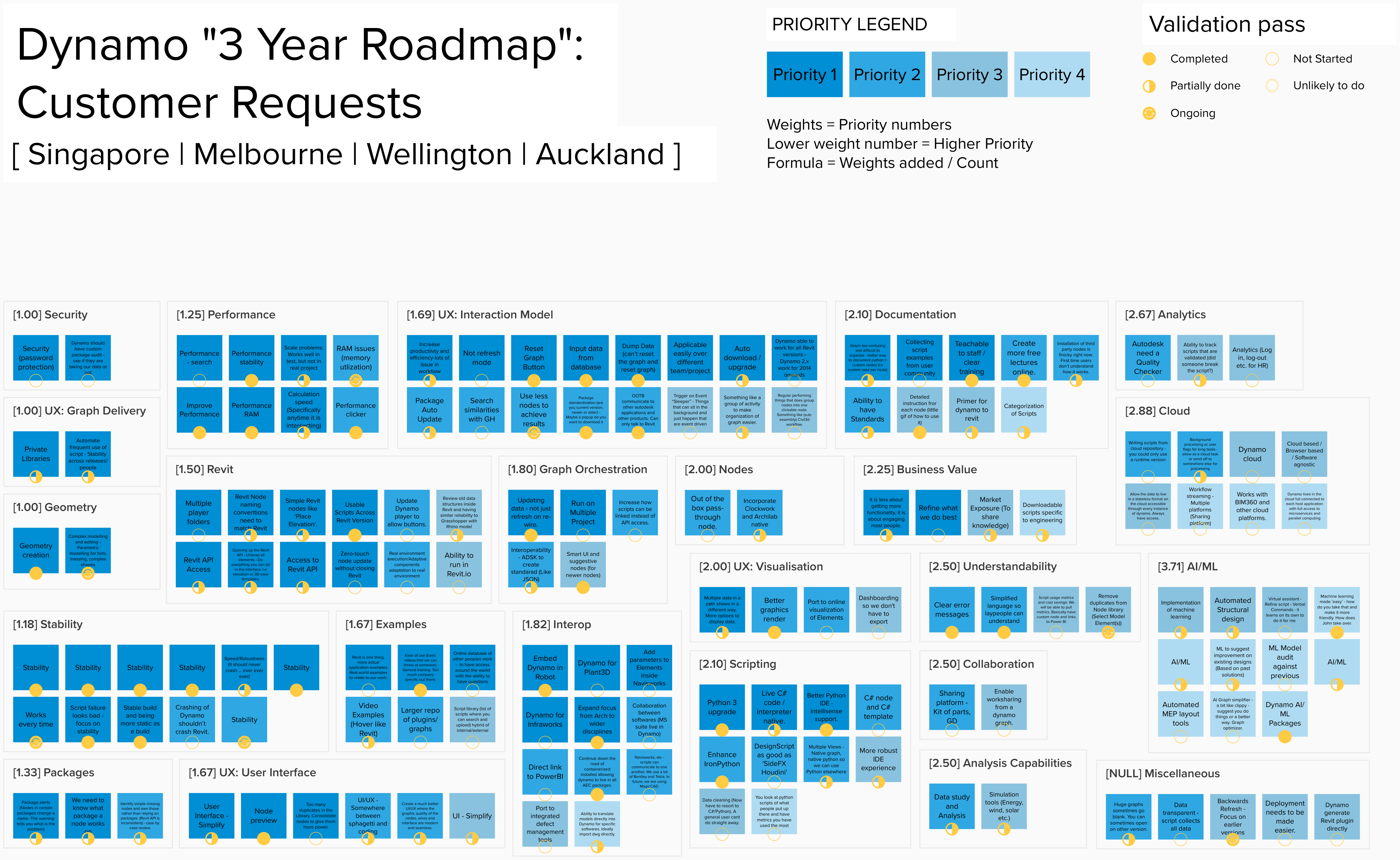
User requests from Singapore, Melbourne, Wellington and Auckland
So why was this thing picked to be worked on over that thing?
These World Tour requests formed a large part of the evolution of Dynamo over the past couple of years, but didn’t form all of it. Dynamo’s development is guided ultimately guided by the end user and how we can best serve you, taking many factors into account; some things required a longer arc of design and planning (i.e. Cloud or AI/ML), some require collaboration with other entities (i.e Analysis Capabilities or Interop) and some we could just get stuck into and forge ahead (i.e. Stability, Performance and User Experience/UX).
The reasons why things were ultimately chosen boiled down to a few major factors:
- Does it meet global demands from users?
- Will in improve the lives of the majority of our users?
- Is it actionable within reasonable timeframes? (Note: This doesn’t mean we are not doing large multi-year projects, but rather chunk them down into releasable pieces)
- Will it make it easier and swifter for you to do your work?
- Will it make it easier for you to share your work for others to use?
Based on these factors, and the intersection technology, design, and business, as well as the ultimate desire to defend the customer, the work done on Dynamo is an expression of what the team thinks is most appropriate for Dynamo. This also moderated by the Dynamo Wishlist where we pull in ideas, or the essence of ideas that meet these intersections.
We can illustrate this with an example around the thematic of Stability:
-
Stability was the most important thematic from the “Singapore, Melbourne, Wellington and Auckland” Roadmap, and pretty high up on the list with the “San Francisco and London” Roadmap
- Stability increase is a business metric that drives us towards strong and resilient products
- Crashes in Dynamo were a sizeable chunk of Dynamo Forum questions and Dynamo Github Issue Reports
- Dynamo crashing inside of in-process host applications (Such as Revit) mean the host application crashes also. This can result in a massive amount of work lost and user frustration
So we spent a significant chunk of effort on guarding features in Dynamo, of building in redundancy and resolving common crash pathways. So much so that the stability of Dynamo has gotten 65% more stable from version 2.0 to version 2.10 and we’re not stopping there!
So what do all these golden dots mean?
In a nutshell, we hit a lot of things, have a lot of things in play and have yet to start a lot of things… insightful, I know. Bearing in mind the nuance and that this is our viewpoint we have the following overall numbers between both Roadmaps:
Completed | Full dot= 23.9%Partially done | Half-full dot= 30.5%Ongoing | Circular arrow= 5.8%Not started | Empty dot= 36.8%Unlikely to do | Double-line empty dot= 2.9%
Which we think is a pretty reasonable spread. Especially considering that an overall positive skew would combine the completed, partially done and ongoing to 60% of requests honored in some way. We strive our utmost here on the Dynamo team to deliver value every single day, delivering the best possible experience that we can, and we take great joy in making Dynamo all that it can be. It goes without saying that also doesn’t capture all of the work done in this time period either, of which there is lots!
I want to give the biggest of shout-outs to all involved in both seeding these ideas and delivering upon it; the Dynamo developers (Devs), the experience designers (UX), the quality analyst’s (QA), development contractors, and of course you, the users, who filled this domain space with these hundreds of awesome ideas. You are all awesome.
OK cool, but why did you write all this anyway?
Mindful that this is a snapshot in time, representative of back then; 2019 in a pre-Covid world, two years ago, with people in their respective careers who now know more, and of a subset of Dynamo users who we could reach. All this means that we don’t want to rest on our laurels, we don’t want to only use this data to make decisions. We don’t want to lose touch. While this isn’t the only data points we’ve used to make decisions (It’s one of 10’s to 100’s!), it’s an extremely relevant one as it comes directly from you – the user base.
Being mindful of said snapshot, we want to run this exercise again and validate the state of play today with a mind to the future of tomorrow. So this is an invitation to have your 2 cents, to come talk to us about the Dynamo of tomorrow and play an active part in the direction it takes.
If you are interested in participating, then please register your interest here and we will endeavour to talk to as many of you as we can, tailoring our discussion across as diverse a range of people as possible.