The Project
Red Sea International Airport began construction in 2021, 15 kilometers inland from the coast of the Red Sea.
The Red Sea International Airport
It is being designed by Foster + Partners in collaboration with architecture studio Jacobs as a gateway to the wider development.
Its curved form and plan are intended to emulate the desert landscape and will be characterized by five dune-like pods arranged around a central drop-off and pick-up space.
Introduction
In the rapidly progressing world of architectural workflows, the quest for innovation is relentless. This blog post casts a spotlight on the groundbreaking strategies implemented in two megaprojects that have recently graced our portfolio. The Al-Wasel Tower, with its workflow detailed in an earlier post, serves as a prelude to our exploration of the Red Sea International Airport project. Both undertakings presented a spectrum of geometrical complexities, from the extreme double-directional curved surfaces to other engineering challenges that necessitated the training of AI models—a topic for a future discussion.
Building upon the knowledge gained from the Al-Wasel Tower, we confronted the Red Sea International Airport project, determined not to repeat past mistakes but to innovate and streamline our approach.
The Al-Wasel Tower Approach Revisited
Al-Wasel Tower Site Image
Before diving into the Red Sea International Airport project, let’s briefly revisit the Al-Wasel Tower’s methodology. The tower’s panels, adaptive component elements rich with fabrication parameters, were designed to configure the geometric behavior of the facade.
Panels at an arbitrary Zone
The technical solution involved creating multiple panel configurations—flat and non-flat—to accommodate the tower’s complex curvature. This approach, it led to a highly nested family structure within Revit, which, while robust, proved to be a time-consuming and cumbersome method for project updates.
As updating each zone, which consists of 4 to 5 levels on average, needed 9-12 hours to finalize the reloading process for each revision.
This time barrier was cumbersome and very stressing with tight deadlines.
Here’s an overview of a small number of nested family’s configuration of the Al-Wasel Panel.
Nested Families structure of the Al-Wasel panel
Formulas inside the panel family of Al-Wasel Tower
The Red Sea International Airport: A New Paradigm
While we handled multiple challenges in the project, that includes Roof cladding (which needed training a coordination prediction-based AI Model), gutters and Ceiling paneling of the Red Sea International Airport.
Overview of the Roof Cladding of the Red Sea Airport
Overview of early design stages of the Ceiling panels and Roof cladding
Perline’s analysis and Gutter model
Overview of the roof cladding in POD 5
In this blog post I’ll focus on the Ceiling paneling challenge, which presented us with an opportunity to reflect on our previous approach and opt for a more efficient solution.
The project contained more than 10,000 double-directional unique curved ceiling panels.
Which in regular scenarios is impossible to implement manually in a very limited timeframe.
Ceiling paneling different elements and geometry
Dynamo to the Rescue
The powerful workflow we developed in Dynamo and Synthesize toolkit package, allowed us to maintain a “Panel” configuration by utilizing only the coordinates and lines of a very basic Adaptive Component families—a simpler and more maintainable method compared to the complex geometric relationships in the previous Al-Wasel Adaptive Panel.
In addition, through smart coding, we developed an updatable system that significantly reduced the need for laborious updates and maintained the integrity of the project’s annotations and relationships.
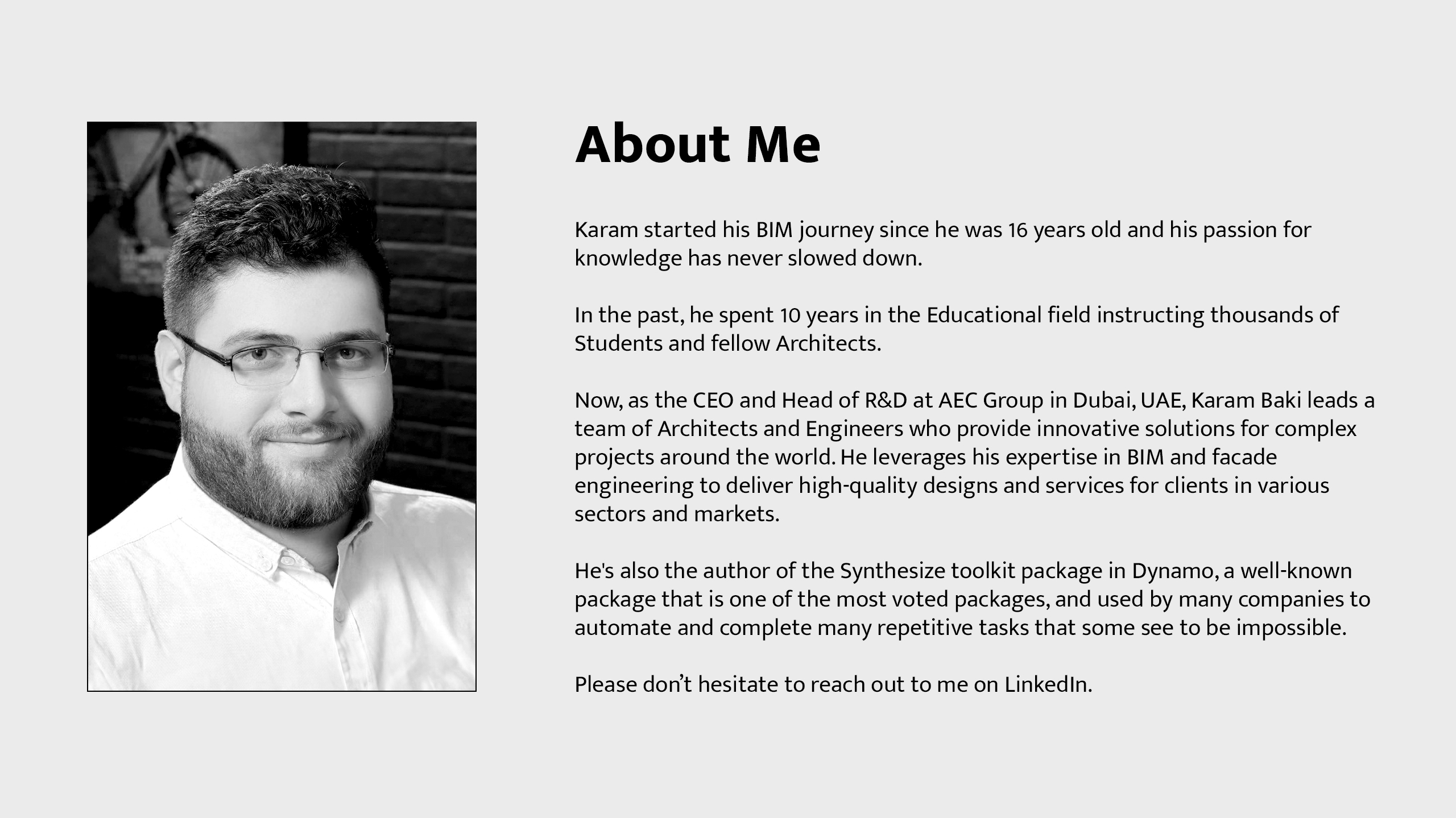
Synthesize toolkit is publicly available for community use, created and maintained by Karam Baki
The Synthesize Toolkit package in Dynamo
The Workflow in Action
The project had 5 Pods, we started with a set of surfaces, a surface for each Pod, created in Fusion 360, inserted to Revit via [KFamilyInsert] node in Dynamo, which is the smartest geometrical node we’ve ever created, that does automatically heal and translate different sources of data into Revit native geometry (we might discuss later on another post), thus we represented the base surface of the Ceiling Panels.
And with Dynamo, we placed Empty Adaptive Components that represented the Ceiling Panels as Placeholders and used a specialized Dynamo node to align the adaptive points consistently, similarly to Al-Wasel Tower’s auto placement and sorting mechanisms.
Fusion 360 ceiling surface inserted to Revit as a reference
Naming System and Panel Types
A naming system was implemented to automatically assign identifiers [Panel_ID] to each panel, with the flexibility to rename them based on an external Excel file.
In addition, exterior and interior Family Types were assigned to the empty Adaptive Components Placeholders, this system was crucial in managing the Exterior and Interior panels geometry, the latter featuring additional U-Channels for structural support.
Naming and type structure for the ceiling panels
Code-Driven Generation
We introduced a code that is capable of reading profile families from the company’s web server, getting their lines and coordination systems, and map them onto the adaptive components placeholders, generating all parts of the panel.
Code overview
We then batch utilized this code, to produce a wide range of panels across multiple Revit instances at the same time!
Distribution of panel creation across multiple instances
As-per the illustrations above, we tricked Revit by utilizing all of the available CPU cores in a machine by splitting the CPU core utilization dynamically, this process was not only efficient but also scalable, generating 1,000 panels in just 15 minutes per instance.
Folder structure long with .SAT and .CSV files generated out of Dynamo
Output and Integration
The generated .SAT files, were handled in another code that mapped subcategories, material colorization, and separation by custom instructions, Concurrently, .CSV files containing panel data were produced, ensuring that all quantity-related information was captured and ready for integration.
Overview of fabrication orders automatically generated.
Workflow In Action
The following is a comparison between Multiple Instances and Single Instance workflows, the difference of time completion is obvious.

Paneling process in action
Multiple (10 Instance) workflow time: 15-20 minutes.
Multiple (4 Instance) workflow time: 1:30 hours.
Single (1 Instance) workflow time: 5-6 hours.
Updatability: Breaking the Time Barrier
The innovative approach taken with the Red Sea International Airport project shattered the constraints of time-consuming updates. By providing the ability to re-generate and re-utilize .SAT and .CSV files automatically, we were able to overwrite existing panels with updated details quickly and efficiently, maintaining project continuity without the need for recreating and placing panel families from scratch.

Updatability in action
Video Presentation:
We also have a video presentation prepared showcasing the ceiling paneling process and a sneak peak of the fabrication orders we were able to automatically generate as well, along with other insightful details, along with some tools to replicate the paneling work at your device, just to get a sense of how smooth the whole process is.
Presented at AU 2023 with Sol Amor and Lilli Smith at Dynamo Briefing Session
Conclusion
Ultimately, the Red Sea International Airport project not only benefited from the lessons learned from the Al-Wasel Tower but also set a new standard for efficiency and adaptability in BIM workflows. The strategic use of adaptive components as placeholders, combined with the power of Dynamo coding, resulted in a workflow that is both precise and flexible, with a precision reaching down to 2mm clash free results for a complex double directional curved geometry.

Navisworks clash test in action
Sign off.
We are certain that sharing these insights and workflows, along with some of the tools, will empower industry professionals to achieve greater efficiencies and foster innovation in their own projects.
The strides made in these projects are a testament to the potential that lies in embracing new technologies and methodologies in the realm of construction and design.
Stay tuned for more updates as we continue to push the boundaries of what is possible in the world of BIM and architectural workflows.
Best Regards,
Karam Baki
Head of R&D / BIM Manager
AEC GROUP